Understanding the Basics of the Enneagram
What defines an Enneagram type?
An Enneagram type isn’t defined by the personality traits people commonly associate with it (kind, helpful, intellectual, etc.), but first and foremost by what we call an “avoidance pattern.” This avoidance pattern is at the core of each Enneagram type.
It’s not always easy to spot—especially because it often operates unconsciously. The whole point of the Enneagram is to help you become aware of that pattern so you can work with it and grow.
What are the 9 Enneagram types?
Type 1: The Perfectionists
Perfectionists try to avoid their underlying anger. Guided by a strong sense of right and wrong, they often have a sharp inner critic. They work hard to avoid mistakes that might call their competence and reliability into question. Read more about Enneagram Type 1.
Type 2: The Helpers
Helpers try to avoid acknowledging their own needs. They’re usually far more comfortable giving than receiving. They work hard to be loved by the people who matter to them—and to avoid letting them down. Read more about Enneagram Type 2.
Type 3: The Chameleons
Chameleons try to avoid failure. They work hard to avoid being unproductive, inactive, mediocre, or looking bad. Read more about Enneagram Type 3.
Type 4: The Dreamers
Dreamers try to avoid being ordinary. They work hard to avoid feeling rejected, insignificant, misunderstood, or inauthentic. Read more about Enneagram Type 4.
Type 5: The Observers
Observers try to avoid feeling empty inside. To compensate, they often pursue knowledge nonstop. They work hard to avoid intense emotions (especially fear), intrusive people, and taking action before they feel fully prepared. Read more about Enneagram Type 5.
Type 6: The Loyalists
Loyalists try to avoid uncertainty. They work hard to eliminate ambiguity—whether in ideas, relationships, roles, or situations. They tend to distrust anything that doesn’t align with the groups or beliefs they identify with, and they often question what hasn’t been proven. Read more about Enneagram Type 6.
Type 7: The Enthusiasts
Enthusiasts try to avoid emotional pain. They work hard to steer clear of sadness, discomfort, frustration, limitations, constraints, and boredom. Read more about Enneagram Type 7.
Type 8: The Challengers
Challengers try to avoid vulnerability. They work hard to avoid feeling weak, being dependent on others, unfair (or overly restrictive) rules, and being controlled or manipulated. Read more about Enneagram Type 8.
Type 9: The Peacemakers
Peacemakers try to avoid conflict. They work hard to avoid confrontation, making too many demands, and losing their sense of inner calm. Read more about Enneagram Type 9.
What is an Enneagram wing?
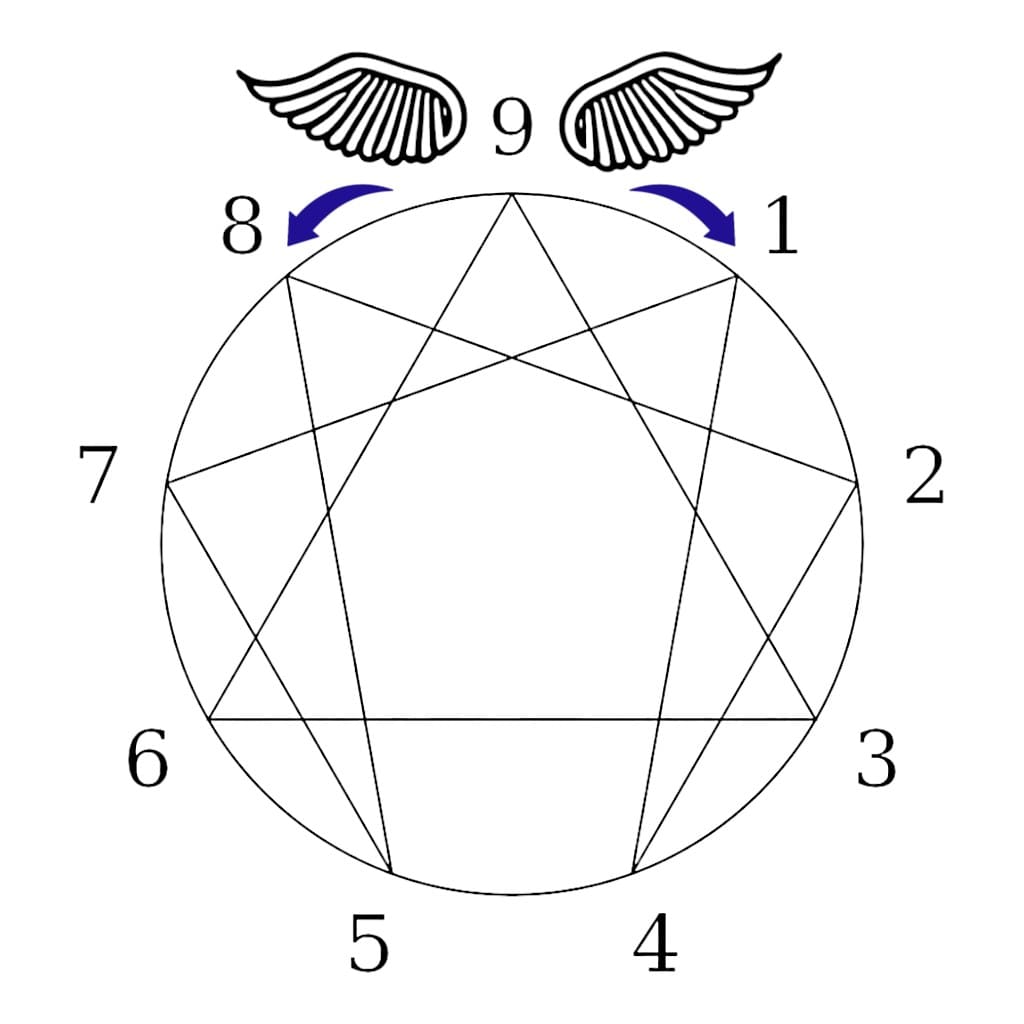
Type 9’s wings
Each Enneagram type has two neighboring wings: the type before it and the type after it. For example, the wings of Enneagram Type 3 are Types 2 and 4. Type 9’s wings are Types 8 and 1 (since there is no Type 10).
A person’s wing is the one of the two that most strongly influences their personality. So if someone is described as “Type 3 wing 2” (“3w2”), it means Type 2 shapes their Type 3 expression more than Type 4 does—and, for example, they may be more people-oriented (a trait often associated with Type 2) than a Type 3 wing 4.
A wing adds nuance, but it’s still a secondary influence compared to the core type. For instance, a Type 3 wing 4 is still very much Type 3, simply with a stronger Type 4 flavor than Type 2. Wings are best viewed as a subtle modifier—not as important as the core type itself—especially because the core type is what points to the avoidance pattern you’ll get the most value from working on for personal growth.
Can you have multiple Enneagram types?
For most people, no—and that’s a good thing. At its core, an Enneagram type isn’t a “personality label” so much as a habitual pattern. And if learning to work with one pattern is already challenging, juggling several would be even harder. If it does happen, it’s more likely during an extended “unhealthy” period, when patterns from other types can pile on top of your baseline one. That said, it’s completely normal to recognize traits from multiple types. We can all develop the strengths of every type without being that type—especially when we’re healthier, more grounded, and more in control. For example, a Type 9 can be just as generous as a Type 2, and Type 3s can be just as intellectually curious as Type 5s. What primarily sets them apart is their underlying avoidance pattern.
Can my Enneagram type change over time?
It’s uncommon, but it can happen—depending on your environment, strong new influences, and the choices you make. Over time, you may start relating more to a different avoidance pattern and shift toward another Enneagram type.
What are the integration and disintegration types?
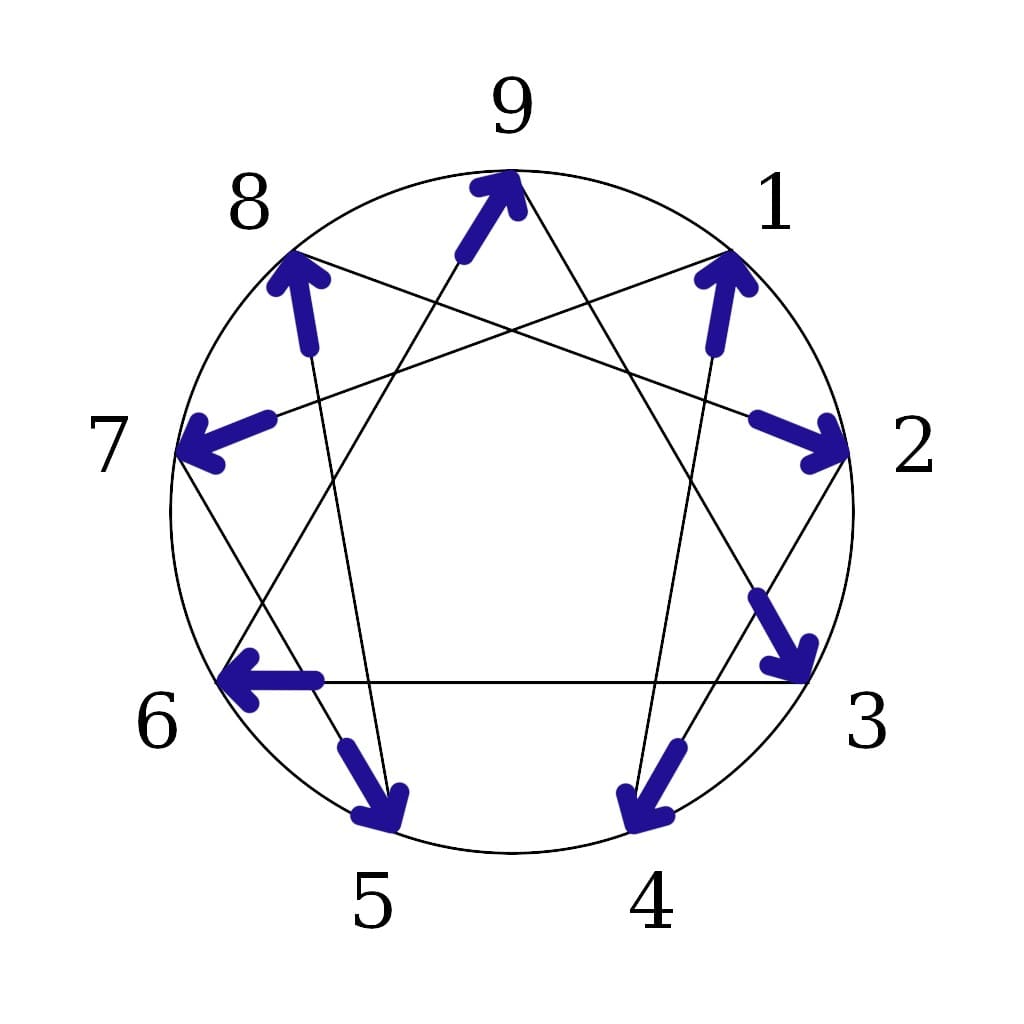
Integration paths (blue arrows)
Integration and disintegration types describe where each Enneagram type tends to go under stress or growth. When you have a healthier relationship with your core avoidance pattern, you often “integrate” and show the strengths associated with another type. When you’re under pressure, you may “disintegrate” and slip into less healthy patterns associated with a different type. Two people with the same core type can look very different depending on how “healthy,” “unhealthy,” or “in-between” they are.
As you become healthier, you gain access to a wider range of positive traits (and any type can develop traits commonly associated with any other type). The integration direction is often quite different from the core type, which is one reason it can be a helpful sign of genuine growth.
Disintegration highlights the negative patterns your core type typically tries to avoid. If those patterns start showing up, it can be a strong signal of distress and imbalance.
What is a healthy or unhealthy type?
Someone is considered “healthy,” “unhealthy,” or “average” based on how well they manage their core pattern—both internally and in their relationships. Two people of the same Enneagram type can be very different depending on how they handle that pattern. That’s why each type description on our site includes “At Their Best” and “Under Stress” sections. You may move between them depending on what you’re going through, how you cope, and what’s happening in your life. If you’re “in balance” most of the time, you’re considered healthy. If you’re “out of balance” most of the time, you’re considered unhealthy. And if you’re somewhere in between, you’re considered average.
What is the best Enneagram test?
When you’re new to the Enneagram, it helps to remember that the Enneagram is, at its core, a framework—not a test. A test can help you narrow down your type, but you’re still the best person to determine what fits you. That’s why it’s important to use a high-quality test—so you’re not misled and you don’t miss out on what the Enneagram can offer.
This Enneagram test was designed from the start to be as reliable as possible and to help more people discover their type. A strong test requires not only well-written questions, but also serious analysis of results to refine the scoring and improve accuracy. That work began with the very first version of this test, when it was first published online in 2018.
Over the years, we’ve continued refining our algorithm using millions of results and thousands of user feedback reports (with 81.3% reporting that the test correctly identified their primary Enneagram type).
How long does the test take?
This Enneagram test includes 72 questions and takes about 10 minutes.
Is this Enneagram test free?
Yes. This is a free Enneagram test. After you complete the test, you’ll be able to view your results immediately—at no cost.
Is an email or sign-up required to get the results?
No. You don’t need to provide an email address or sign up to get your results. Your results are shown instantly, free of charge.
What do the free Enneagram test results include?
Your free results include your core type, your wing, an analysis of your responses, your score for each Enneagram type, and a full description of your Enneagram type. Your results also include a personalized advice report based on your answers. All this for free.
Do you sell any optional add-ons?
No. We don't sell any optional add-ons. The Enneagram test and the full results are 100% free.
What are the limitations of this Enneagram test?
Like any online Enneagram test, this one has some limitations:
- Self-reported answers: Your results depend on how you answer the questions and how you perceive yourself.
- No test is perfect: While this test is designed to help you identify your core Enneagram type and wings, no Enneagram test can guarantee 100% accuracy.
- Limited scientific validation: Scientific research on the Enneagram theory has shown mixed results regarding its reliability and validity as a personality assessment.
This test is best used as a tool for self-discovery and personal growth rather than a definitive psychological assessment.